Archive for the ‘Good death’ category

Wednesday, 25 January 2012

Publishing event of the year!


The Natural Death Handbook, Fifth Edition

A thoroughly updated and revised edition of the Natural Death Centre‘s celebrated handbook. Now presented alongside a new collection of essays on death, dying and funeral practices by doctors, historians, authors, poets, theologians and artists including Richard Barnett, David Jay Brown, Dr Sheila Cassidy, Charles Cowling, Bill Drummond, Stephen Grasso, Maggi Hambling, Graham Harvey, Gary Lachman, Nick Reynolds, and Dignity in Dying.

It’s out in May 2012!

Categories: Academia and death, alternative funerals, Art and death, ashes, Assisted suicide, Atheism, Attitudes to dead bodies, Attitudes to death, bereavement, Books, bureaucracy, burial, burial at sea, burial depth, Care homes, Carla, celebrants, cemeteries, ceremony, Children, Children and funerals, Co-op, Co-operative Funeralcare, coffins, cremation, crematoria, Cryomation, Dead people's rights, death and funerals, Death masks, Death; Good death, Dementia, Digital will, Dignity, direct cremation, Divorce, DIY funeral, Dress codes, dying, Embalming, End-of-life issues, eulogy, euthanasia, Exit, family funeral directors, Formality vs informality, funeral, funeral cost, funeral customs, funeral directors, Funeral flowers, funeral food, funeral music, funeral photography, funeral plans, funeral poetry, funeral pyres, funeral reformers, funeral trends, Funerals for the unborn, funerals in other cultures, Gangster funerals, Ghosts, Good death, green funeral, Grief, Hearses, home funerals, Humanists, Humour, Immortality, independent funeral directors, Jazz funeral, Legal rights, Living funerals, Lonely funerals, Longevity, medical interventions in dying, memento mori, Memorial service, memorialisation, Movies, multimedia, music, National Association of Funeral Directors, natural burial, no service by request, Nokanshi, obituary; epitaph, onlime memorial sites, open-air cremation, Organ donation, Ossuary, Paranormal deathbed experiences, Pauper funerals, perceptions of funeral directors, Personalisation, pet cemeteries; pet and owner burial, Plan your own funeral, Poetry, Post mortem photos, pre-need plans, previous partner, prisons, Probate, Processions, Reasons to go to a funeral, Religious funerals, Requiem Mass, resomation, Ritual, SAIF, scandals, Secular approaches to death, self-deliverance, sex and death, shroud, Social Fund Funeral Payment, spiritualism, suicide, Tahara, Taste, traditional funerals, Transitus, Transparency of ownership, tributes, viking funeral, Virtual funeral, What do we die of and when?, what does dying feel like?

Monday, 23 January 2012

There were six of us in the house. Seconds ago there had been seven.

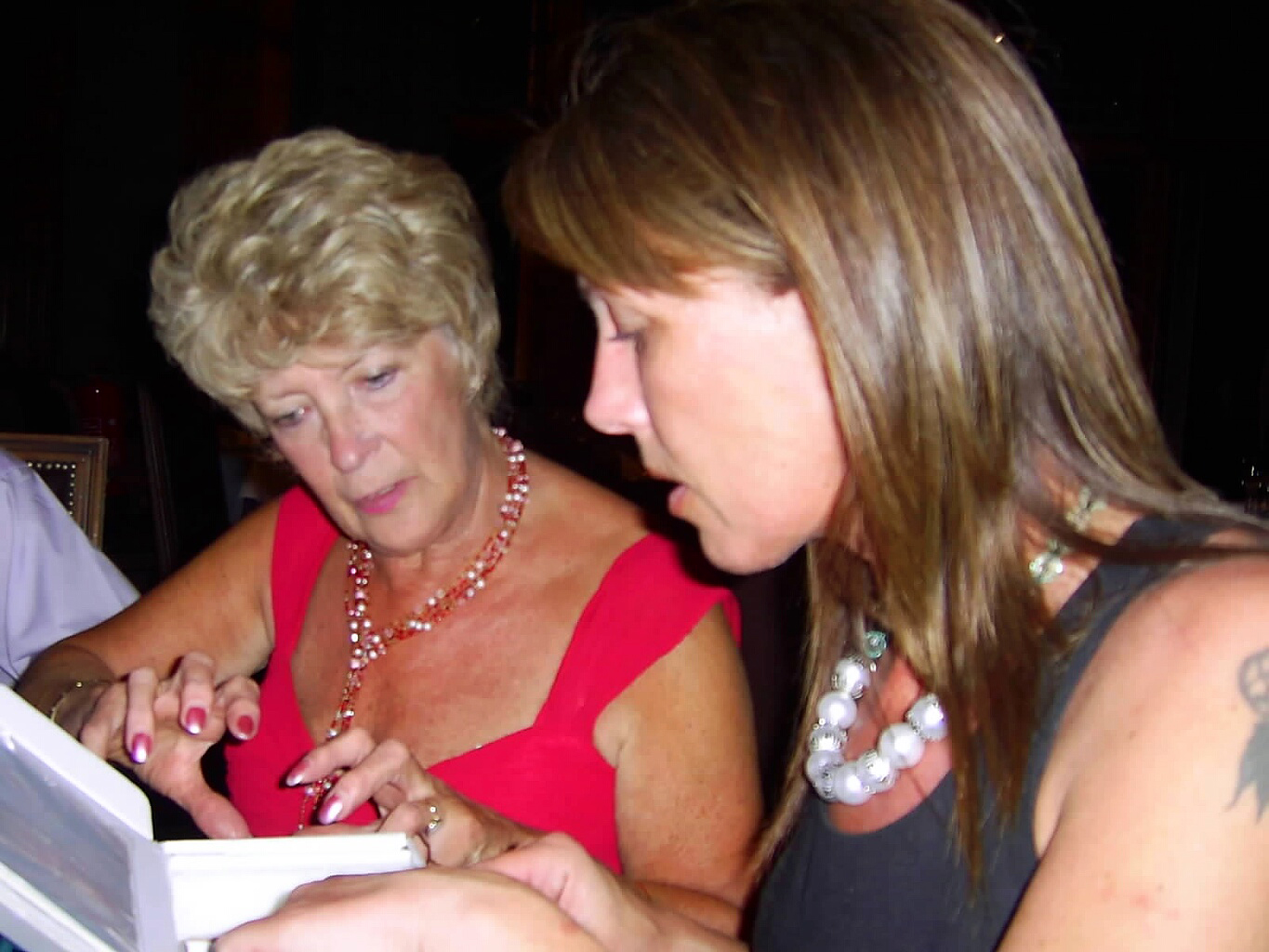
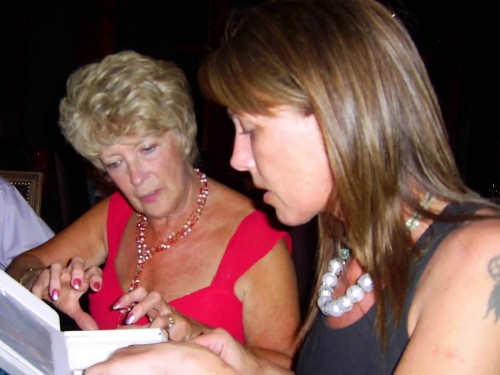
Fran and her Mum on her 70th


Fran Hall, a funeral industry practitioner of many years’ standing, much admired by the GFG, now works as a consultant. She is also the newly-appointed Chair of the Natural Death Centre. For years Fran successfully managed to balance detatchment and empathy in her professional life, so how did it feel when one of her own died? Here, she tell us. 


It’s a rum thing, this death business. You can familiarise yourself all you like with the subject, read every book, article or blog there is to read, immerse yourself in working daily alongside the dying or the dead, consider yourself an expert on the ‘D’ word, and then suddenly you find yourself wrong-footed, knocked sideways out of theory by a swipe from the cold bony finger of the grim reaper.

For years I have grown a reputation for knowing all about death. From humble beginnings as a (completely untrained) funeral arranger, through qualifying with a diploma in funeral directing and then veering slightly sideways to participate in the fast expanding world of natural burial as a marketing manager, I have explored many avenues, and gained some notoriety within the business at the same time. I have sat with stunned, weeping families, bathed cold stillborn babies, collected broken bodies from the roadside or train tracks, cut decaying corpses down from loft hatches with white faced police constables standing by, dressed little children in their pajamas or favourite outfits, coordinated plans for huge ceremonies that needed roads closed and police escorts, conducted hundreds of corteges, written and delivered numerous ceremonies, and been intimately involved every time with the people I served.

I considered myself pretty sorted when it came to dealing with the emotional stuff, checking in with how each contact was impacting on me and those around me, crying sometimes, but not often – you find a way of assimilating some of the worst things you see, and you support each other, because people outside the hidden world of undertaking just don’t get it. Nothing really got through the defence system I created, not enough to impact on me. I was on top of it, cool with mortality, and therefore cool with the fact that at some point it would be my body on the tray in the fridge, or the body of someone that I loved…

And currently, the body of my mother is lying in a fridge somewhere within Kings College Hospital. She’s been there almost exactly a year. She died on January 23rd 2011, and what remains of her will probably be cremated sometime in 2014 in some godforsaken crematorium in South London. Her decision to leave her body to medical science was something we all applauded when she produced the paperwork back in 1999, such a thoughtful, generous thing to do. I had no idea of the actual effect it would have when the time came and we were left without the comfort of a ritualised farewell to her existence. That’s what I mean about being wrong-footed. 

Let me go back. It was a mercifully brief illness that snuffed out the bright light that was our mother. Always the centre of attention, glamorous, bossy, difficult and charming, she was a true Leo, a powerfully dominant matriarch at the heart of our family. The drama of being the hostess of a Grade IV glioblastoma multiforme – the most deadly of brain tumours – was only fitting for someone who shone so brightly and who numbered her friends in the hundreds. She was fit and healthy in the August, and dead four months later – sixteen weeks exactly from diagnosis. In those sixteen weeks I realised that all my years of being alongside death had been just that, a journey beside others, a second hand experience. My practical knowledge was useful – I knew how to talk to the professionals, what questions to ask, how to get the help we needed, I was able to do stuff that my brothers couldn’t, because I knew my way round the system. Emotionally it was easier for me too, I had learned how to deal with grief over the years, knew what to expect – and yet being immersed in the swirl of feelings that ebbed and flowed during those four months was something quite new.
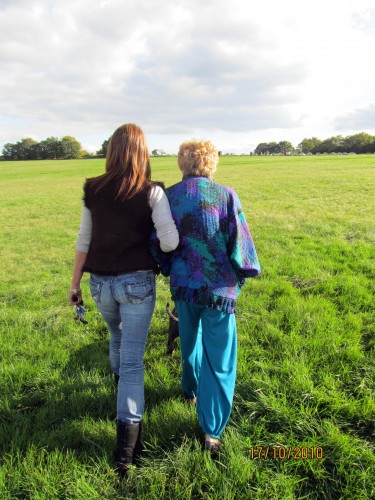
 

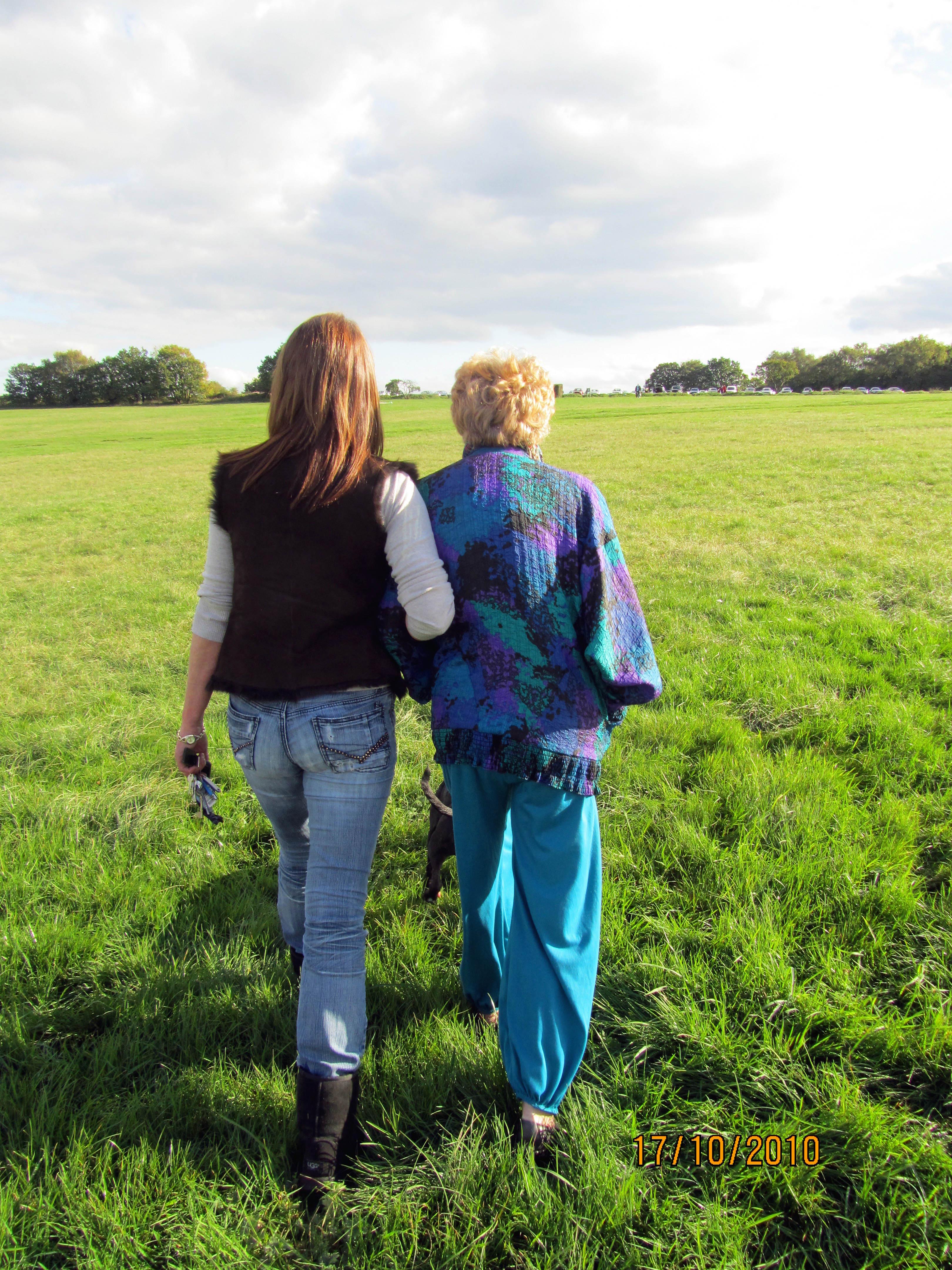
Walking on Epsom Downs on the last all-family day out


We were incredibly fortunate, the planets had aligned themselves in such a way that we were able to give our mother the best gift, a death at home in the house where she had lived for fifty years. Not that she discussed it at all – she never once spoke about death, she refused to be drawn into any conversation about her deteriorating health, somehow complying with hospital appointments, radiotherapy sessions and visits from the Macmillan Nurses without ever acknowledging the unspoken fact that everyone knew. Out of earshot my brothers and I had long conversations, each of us at different stages of acceptance of the inevitable, but in her presence we took our cue from her and kept conversation light and easy.

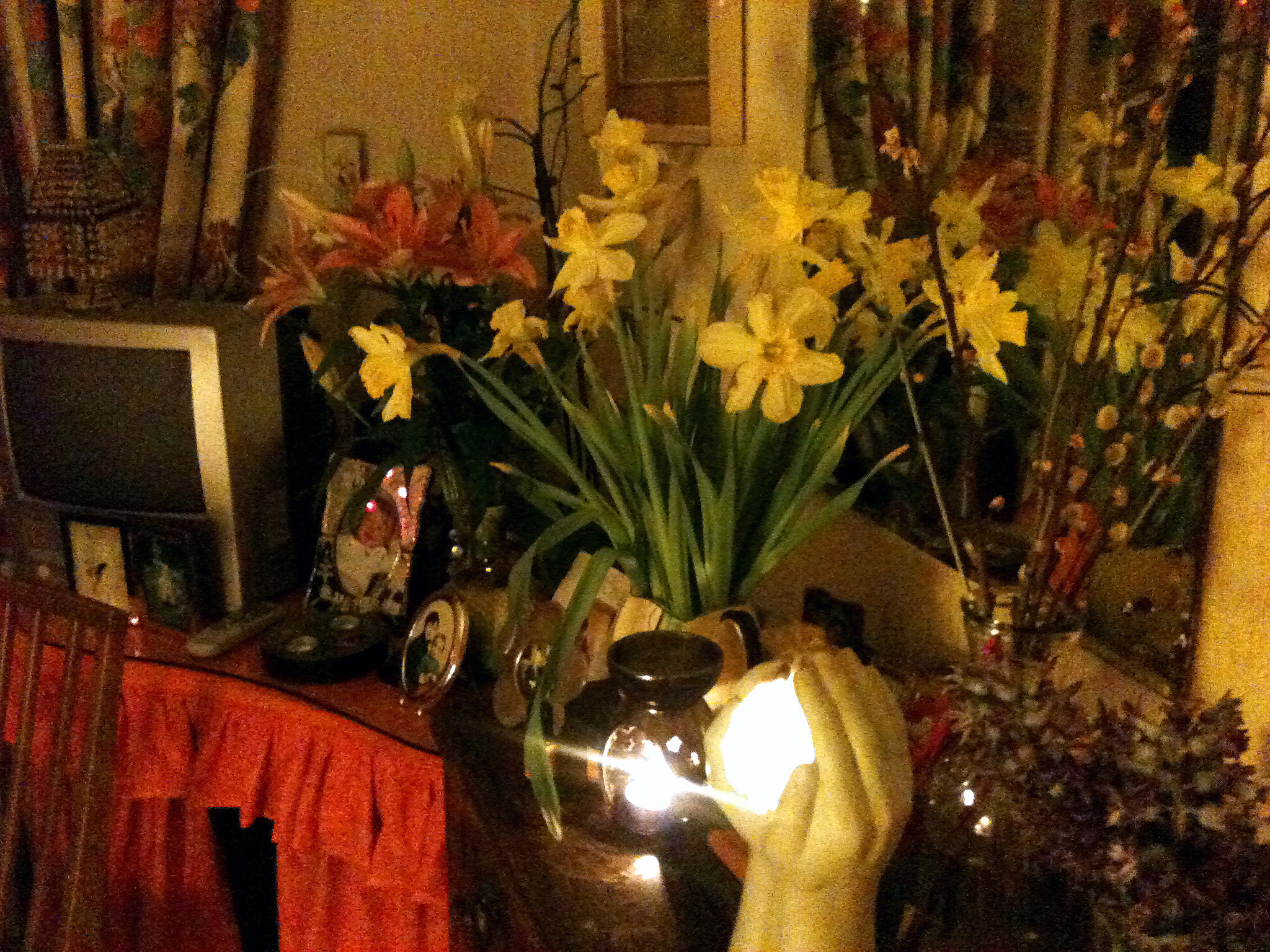
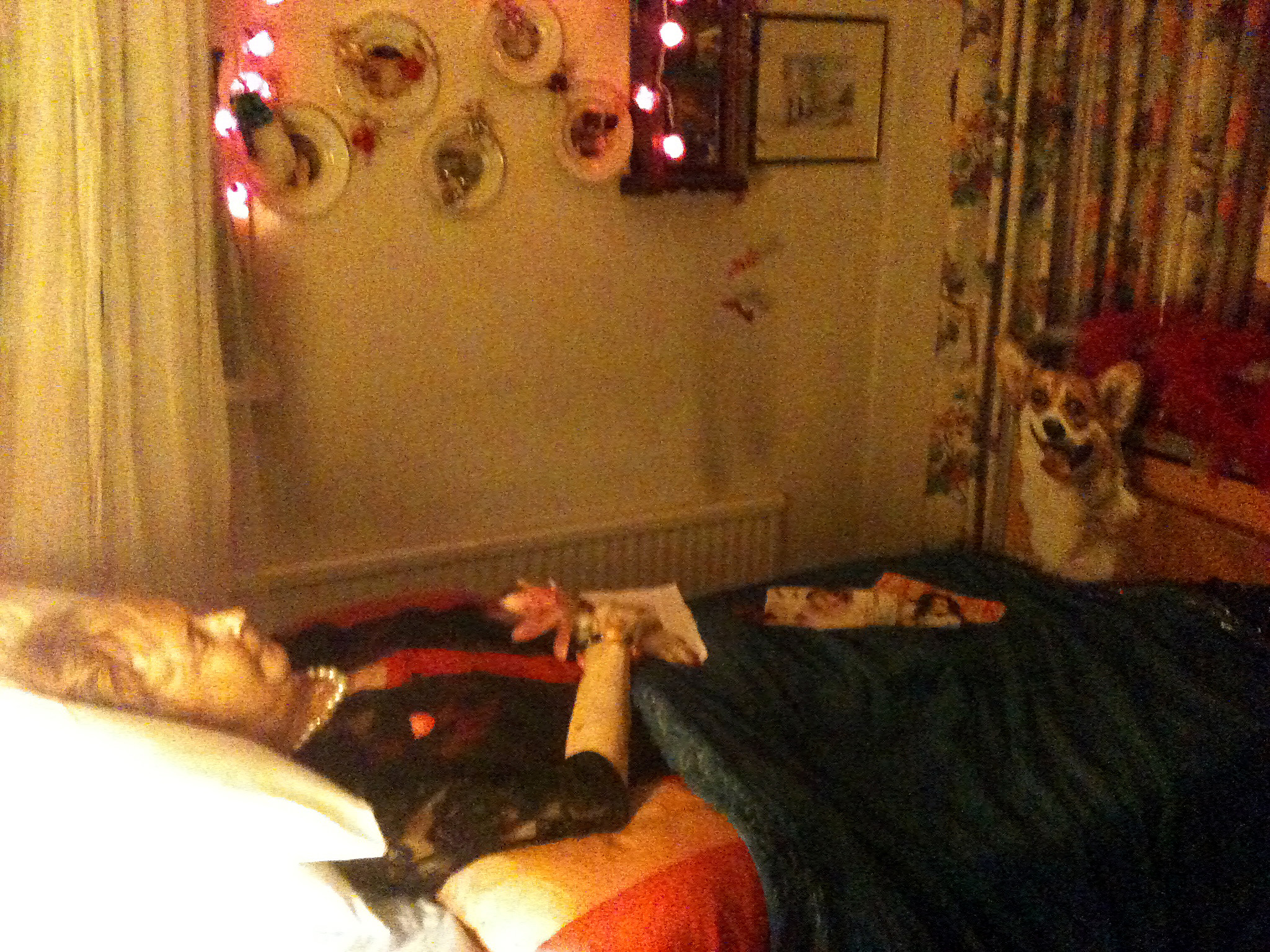
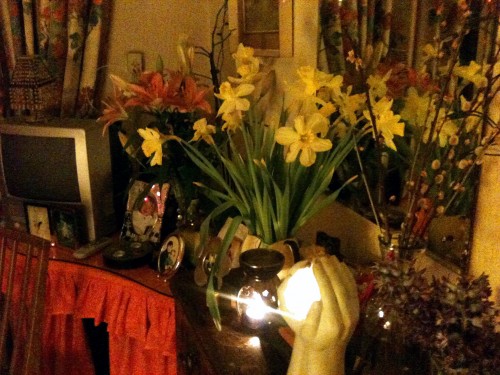
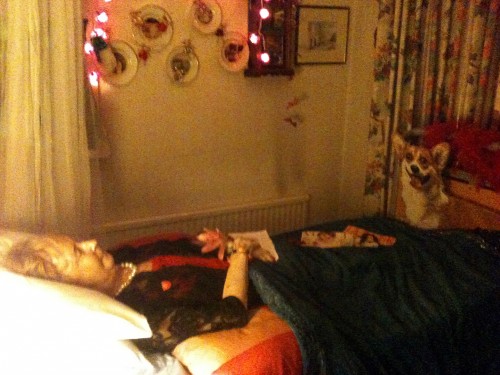
The cruel indignities of a failing body are very basic, very simple things that signpost the shortening path ahead. Gradually, gradually the world closed in – in October we walked as a big family group on the Downs, by November she could no longer walk up the stairs, by December she couldn’t raise herself from a chair. The hospital bed and commode arrived, furniture was shifted and a boudoir created in part of the living room, complete with ambient lighting, feather boas and beads, candles and flowers, and drapery over the mirror so she didn’t catch sight of her features bloated by drugs. Pleasures became little and intimate – no more grand dinners or shopping for bright coloured clothes, she was happy to have her nails painted and perfume applied and to gaze for hours out of the window. We didn’t know what she was thinking, but she seemed content with her thoughts, whatever they were. And while she passed each day quietly and comfortably, we three journeyed with her towards the end, each of us in the experience, part of it, not just observing it.

We were blessed with the kindest of carers to help us in the last few weeks, wonderful ladies who arrived every few hours with gentle hands and loving hearts. They bathed her and changed her, spoke softly and cheerfully to her, marvelled at her grace and serenity and shared jokes with us while they wrote their notes before slipping away. We were able to just be with her, offering food and drink, sitting with her while she slept, changing places with the various friends and family members who came every day to see her. It was a wonderful, dreadful time, a time in which we were able to contemplate what was coming and reach a kind of acceptance, safe in the familiar surroundings of the house we had all grown up in. I know how lucky we were, so many other families aren’t able to have such a softened approach to a death.


The day before she died all of her grandchildren were together in the room – separated from the bed where she lay semi-conscious by a DIY partition, nine of them sprawled on sofas and chairs, playing cards, eating pizza, fooling about quietly to the accompaniment of ‘Nan’s music’. Probably the last sound that she heard was their laughter – it was surreal, and yet so right to have them all being normal just feet away from their dying grandmother. Each of them came and went as they wanted to her bedside, holding her hand, stroking her hair. When the older ones left that night, they all knew they wouldn’t see her again and this was one of the hardest things, seeing my children leave the house stumbling with grief and tears and holding each other tightly. The little ones wanted to stay, so we made beds for them on the floor, and they slept as we adults sat vigil with our mother as she died.

You don’t get much preparation for what to do once someone has died. I don’t mean the immediate practical stuff, like closing their eyes, laying them back onto the pillow, wiping their mouth; I mean you don’t really know what to do with yourself. She had left us irrevocably, gone. Completely gone. There were six of us in the house, my brothers and sisters in law, my mother’s dearest friend and me. Seconds ago there had been seven. It was the opposite of being in a delivery suite when a baby enters the world. Bizarre thoughts like that arise unbidden as you experience the profundity of what has occurred. Someone made tea, someone else went off upstairs to be alone, my nephews were gently woken and told, as we had promised them we would, and the adults then had to look after them and try and assuage their grief – a welcome distraction I think.  After an hour or so I went out and walked in the freezing January night to an ancient oak tree a mile or so away and just sat at the foot of the huge trunk and looked at the stars, without thinking. It was beyond thoughts, that night. And beyond feelings too – it was just elemental and unconstructed and without boundary, it was death.

In the morning my sister in law and I laid my mother’s body out, washing her and dressing her and making her look lovely again after the ravages of the night before. We hadn’t rushed to call a doctor to certify the death, and we didn’t rush to call a funeral director either, choosing to keep her body at home all day to allow other family members and friends to come and be with her. This was in direct disobedience of the ‘donation to medical science’ rules, but we judged it cold enough to take the risk, and fortunately for us we got away with it (I wouldn’t recommend it to others though if they needed to ensure the donation is accepted, I had to be somewhat economical with the truth on the phone the following morning!)


Eventually, on the Monday afternoon, an undertaker friend of mine came and collected mum’s body and drove her off to her new role as a cadaver for medical students to practice their skills on. This was yet more uncharted territory, and something that I found really difficult to accommodate. I felt denied the opportunity to ‘lay her to rest’, and really struggled to get my head round the absence of a funeral. After all, that was what I did, I made funerals happen – and I wasn’t to be allowed to for my own mother – that was a real tough one for me. I ended up by substituting a funeral with what was to become the most extraordinary memorial service for her a couple of months later.

It’s been a strange journey, this one from ‘knowledge’ through experiencing to where I am now. Probably the best summary is that I am older and a little wiser – an orphan has more insight than a funeral expert. I’m still buying books on death and learning all the time from others, but the process of being alongside my dying mother has taught me more than anything.


Today is the anniversary of Fran’s Mum’s death.

Contact Fran at franhall [at]sky [dot] com


Categories: Attitudes to death, bereavement, dying, End-of-life issues, funeral, funeral directors, Good death, Organ donation

Wednesday, 13 July 2011

Home Death by Nell Dunn


Posted by Pippa Wilcox


I wish I could tell you that the real-life stories portrayed in Nell Dunn’s play Home Death are over-dramatised.  But they aren’t.  

It seems to be a terrifyingly random lottery out there in terms of whether or not you will stumble across the sort of care package which will result in a ‘good’ death at home – which is the aim of each of the characters we are introduced to in this beautiful, moving, unflinchingly honest 90-minute piece.  

Such a thing as a good death does exist and when someone dies, if they and the people who love them believe it to be as positive an experience as is possible in the circumstances, the difference it makes is profound.

A ‘bad’ death leaves a gnawing, corrosive legacy for those left behind.  A good death results in a sense of pride and — amongst the complexities of grief — a thankful absence of guilt, remorse and torment about the decisions made in the approach to those final breaths.

I know this from speaking with the 200 or so families I’ve worked with in my role as a humanist funeral celebrant.  I’m inspired by hearing about those endings which we would all wish for ourselves and the people we love; and I’m haunted by the ones you wouldn’t wish on your worst enemy.

In Home Death we hear of 7 deaths following cancer and we are spared no detail, no matter how uncomfortable.  We learn of the sense of loneliness and abandonment experienced by the friends and family of the dying; of the steel that appears to have replaced the heart of a doctor attending a dying man; of the desperately chaotic, disorganised and interminable scrabbling around for morphine; of the blood-spattered hospital ward; of the women who might be sent to sit with you in the night and whose only contribution to your well-being is to silently dispense medication and note in a book that they have done so; of the ridiculous insistence that you cannot die in your own home without a “horrible, scary, cold hospital bed.”

We learn that to organise a good death at home for someone we love often requires near-superhuman levels of determination, tenacity, time, energy, courage and an ability to rage against the machine.  And it would seem that above all else, access at the right time to morphine and anti-nausea medication is fundamental and all too often absent.  The NHS does not come off well in this piece.

Nell Dunn, now in her 70′s and renowned for giving a voice to ‘ordinary’ people in her work has assembled this play from her and her lover’s own experience and the experiences of others who had cared for a dying loved one at home. These true stories are told with commitment and integrity by the 11 strong acting ensemble.  There isn’t a weak link amongst them.  The production and performances are pared down, stripped back and utterly convincing.  

It is not wall-to-wall bleakness.  Although it is not so much the more positive stories that you leave the theatre dwelling on, there are some good deaths here as well as some air and light breathed into this piece.  The George and Diana Melly pairing and the trio of Mick, Lisa and Mary in particular provide some welcome laughter and the exchange between Juliet and James lets us off the hook for a while – the other five stories are told directly to the audience.

The Finborough seats might not be the most comfortable but this is one of those venues that makes me feel proud to be a Londoner.  The shamelessly intimate space, the courageous programming choices, the exceptional performing talent which it attracts, the hip and truly sweet theatre and bar staff, the very respectable loos, the (new) air-conditioning, the Firezza pizza which you can have waiting for you when the show’s over and the brilliant array of wines you can order by the glass… what’s not to like?

If you are a stakeholder in palliative care you must see this; if you believe that forewarned is forearmed you must see this. It’s hard to imagine a more effective means of highlighting the issues we all need to be aware of if we, or someone we love, would like to die well at home.


Home Death is currently playing at the Finborough Theatre for only 6 performances over 3 weeks.  Further performances may be added: http://www.finboroughtheatre.co.uk/productions/2011/production-home-death.php


Pippa Wilcox is a humanist celebrant who conducts funerals and memorial services for those who have chosen to live without religion:  http://www.humanistcelebrant.com

Categories: Art and death, End-of-life issues, Good death

Thursday, 30 June 2011

Can you help?

By Caroline Iandoli

Living funerals are gathering in popularity as more people are approaching death with a more positive frame of mind, taking the opportunity to celebrate with the people they love and have been important in their lives. It also means friends and relatives who might not be able to attend the funeral at short notice can say goodbye. This kind of celebration often has a positive effect for those coming to terms with illness and loss.

We aim to reflect this shift in attitudes by making a documentary celebrating life through the lens of the deceased apparent. The film will confront the traditional way of dealing with death, and demonstrate that planning for the end of your life doesn’t have to be morbid. It can be – and for many people is – positive and uplifting.

We are looking for people who are thinking of planning a life celebration to contribute to the film. For more information please contact Paisley Randell: 07554009286 or email us at forgetmenotfilms@mail.com

Categories: Good death, Living funerals

Tuesday, 28 June 2011

The Home Death Movement

I’ve been reading an interesting research report published last month in Australia. Its title: Bringing our Dying Home: Creating community at the end of life.

It examines how networks of unpaid carers can supplement the services of professional carers and enable dying people to die at home. It shows that the lot of unpaid carers need not be one of drudgery, anxiety and isolation, but an experience which enhances bonds in families, among friends and within the wider community. It asks this important question: What if the Home Death Movement (of which there is undoubtedly a global one), named itself as such and claimed a place at the decision-making table?

The report begins by stating how things are now: Most people die in institutionalised care – usually a hospital – resulting in the modern death becoming “cellular, private, curtained, individualised and obscured” This type of death can mean that people “die badly in places not of our choosing, with services that are often impersonal, in systems that are unyielding, struggling to find meaning in death because we are cut off from the relationships which count most to us.” That most people do not experience dying and/or death in places of their choosing is an astonishing fact; a fact that, collectively, we are either ignorant of or just silent about. It is a fact that speaks to our failings as a society at a time of life that occurs for each and every one of us. [P7, refs omitted]

The report concludes: In the research reported here we found that people can and do care for their dying at home with the help of informal networks of community members. And they do it well. This is not to say that it is easy: it’s not. However, people overwhelming felt privileged and honoured to be involved in a caring network at EOL. Participants successfully mobilised and negotiated complex webs of relationships and engaged in acts of resistance to the Western, expert-based approach to EOL care. The knowledge and skills they developed as a result of the experiential, embodied learning about caring at EOL contributed to the development of social capital and community capacity for the people in this study. People’s relationships, on the whole, increased and intensified and these changes were maintained over time. [P8. EOL = end of life]

Importantly, the report adds that the professionals have a duty to support unpaid carers: In order to make sure that these networks are sustainable and that people who provide unpaid caring are not exploited and isolated, informal carers, and networks, need supporting. Carers need permission and practical hands-on help to gather caring networks together and to negotiate the type of help they need … We would also like to see organisations that provide paid care at EOL take on an active role in promoting death literacy and facilitating and supporting informal caring networks from a community development – or health promotion – perspective.

A Home Death Movement. Yes, we need one of those. This excellent report shows us that, far from being an anxiety-raddled ordeal, the experience of caring for our own as they lie dying offers rich rewards both to individuals and to society.

I am indebted to Hermione Elliott, director of LivingWell, DyingWell, who are, later this year, piloting a similar project in East Sussex, for sending me a pdf of the report, which I can’t upload because the filesize is too big. Email me and I’ll send you a copy: charles@goodfuneralguide.co.uk


Categories: Attitudes to death, End-of-life issues, Good death

Monday, 14 February 2011

To accept what cannot be helped

A very good account here by Ann Hulbert of her mother’s response to being told she had an incurable cancer:

Two years ago this coming June my mother—“an 80-year-old in a 60-year-old’s body,” the pulmonologist told her—was ambushed by a diagnosis of Stage IV adenocarcinoma of the lungs … In the windowless examining room at the hospital in Brooklyn, my mother said sadly yet matter of factly, “Well, I guess that’s pretty much what I’ve been expecting to hear. We’ve all got to go somehow, don’t we?”

In her case, facing it meant ruling out treatment—the chemotherapy and radiation that the pulmonologist urged to ease pain and eke out a few more months. “If geezers like me have lots of tests and treatments,” she told the doctor, “there isn’t going to be enough money to spend on the other end. This health-care mess isn’t going to be fixed if we aren’t ready to get out of the way.”

[S]he was a rarity—a grandmother in favor of having the plug pulled and ready to live, or rather die, by that all-but-taboo vision of the end of things. But right then, in that airless room, she needed most of all to rise above an abyss. Look at me, a very lucky old lady who has made it to 80; tell me it makes any sense to rack up huge bills trying to add on an extra couple of months (at best) to a life that isn’t likely to last out the year.

As soon as she’d gotten the cancer verdict, she wanted to dispense with the probing, so expensive and so intrusive. She wanted to escape the dingy hospital corridors, the endless waits, the nurses who dragged their feet and addressed her and my father as though they were dim children, the doctors who urged procedures knowing she was a patient with top-notch health insurance.

All of us wanted what she wanted. Or so we had been saying. We had mostly been believing it, too, and admiring her consistency in sticking to her pull-the-plug approach. How it cut through the confusion, the indecision about competing options, the intimidation in the presence of doctors who had plainly never paused to consider that a patient might simply opt out of their white-coated realm. How it pulled us together—that alone recommended her way, we had been saying, anxious to reassure ourselves that respecting her desires wasn’t just right, but wise. Her clarity didn’t come so clearly to us four. Reared on more than our mother’s staunch Swissness, we were baby boomers, accustomed to intervening and only distantly acquainted with death.

Read the rest of Ann Hulbert’s account of her mother’s dying. It’s a wonderful piece of writing full of things to reflect on. Click here.

Categories: Attitudes to death, Good death, what does dying feel like?

Sunday, 30 January 2011

A time to die

Every week in the Spectator magazine Peter Jones takes an occurrence or development in contemporary society and politics and considers it in the light of what the ancients did when faced with the same circumstances. This week he considers the art of dying. I’d now bung you a link but I can’t: the Speccie does not unleash its content online til it has gathered some dust. The joy of the Spectator lies in the quality of its writing (sadly not its politics). It’s almost worth the cover price for Mr Jones alone. I hope he won’t mind a quote-strewn precis.

He begins:

“So everyone is going to live much longer and will therefore have to work much longer to pay for their pensions. But what is so wrong with dying, Greeks and Romans would ask?

“Homeric heroes sought to compensate for death with eternal heroic glory … Plato argued that the soul was immortal. The Roman poet Lucretius thought that was the problem. For him, life was an incipient hell because of man’s eternal desire for novelty. So as soon as he had fulfilled one desire, he was immediately gawping after another. What satisfaction could there be in that? The soul was mortal, he argued, and death, therefore, should be welcomed as a blessed release.”

Cicero concurred. We run out of things to interest us and are glad to go. “A character in one of Euripides’ tragedies put it more succinctly: ‘I can’t stand people who try to prolong life with foods and potions and spells to keep death at bay. Once they’ve lost their use on earth they should clear off and die and leave it to the young.’

“For Seneca the question was whether ‘one was lengthening one’s own life — or one’s death.’ “

Jones concludes: “Marcus Aurelius put it beautifully: ‘Spend these fleeting moments as Nature would have you spend them, and then go to your rest with a good grace, as an olive falls in season, with a blessing for the earth that bore it and a thanksgiving to the tree that gave it life.’”

Categories: Assisted suicide, Attitudes to death, Death; Good death, End-of-life issues, euthanasia, Good death, Longevity, medical interventions in dying

Friday, 26 November 2010

Materialism gone mad and the what’s-it-all-about question

Here’s an interesting piece by Peter Popham in the Independent, first published in May. I’ve only just found it.

He begins by talking about Christopher Hitchens, who has oesophageal cancer, and how impending death has reconfigured his identity:

“…when the bitter laughter dies away, there is Hitch, locked away from healthy us, in a land where, he discovers, the powers of argument and invective that have made him so widely loved and feared and admired are no longer of any relevance.

“That will be a massive but passing frustration for him, because he has other, more weighty problems on his plate. But it should be a matter of reflection for the rest of us, because we have made of Hitch a modern sage, one of the people we turn to to put us right about things. And suddenly, with death breathing down his neck, what he has to say is of no use to him, and is no use to us, either. He has failed us, and in his blunt way he comes clean about the fact. We treated him like a wise man, but it turns out he was just a clown.”

Which brings him to his point:

“Death is a problem for our age as it was not for ages past, precisely because (speaking of the non-religious majority) we behave as if it were a problem we had already solved.

But we haven’t, of course.

“Church-goers are confronted week in week out with images of agonising death, talk of the “mystery” of death, exhortations to prepare for it, prayers for those approaching it … But in spurning all that we also spare ourselves the weekly dousing in the fact of mortality. And this allows us to go through life as children and animals do, giving the ugly fact that we won’t be here very much longer only the occasional fleeting glance. Then comes the stroke, the aneurysm…”

He then considers those unbelievers and atheists who confront their own demise with equanimity and courage,

“who face the fact of their dying calmly and soberly and treat the disposal of their own life as if it were merely another item in the will … But there is a delusion at the heart of this activity … And the delusion lies in believing that the self is a fixed, unchanging entity, while one’s life is something distinct and separate from it which we can enjoy like an ice cream when it is in good shape but may discard like poison when it turns bitter.”

He quotes the example of a woman who tried to kill herself rather than suffer a long and horrible death. She failed. Popham draws this conclusion:

“Her error lay in having arrived at a commodified view of life, as if it were a piece of property whose disposal was entirely her own business: exactly the sort of mad idea that our materialistic society breeds. Whereas the truth is that the self, to the extent that one can speak of such a thing, is in constant flux, one’s expectations from life are in constant evolution, and nothing we do is “our own business” – everything impinges on everything else in the universe.

We needed to rouse ourselves from the sleep of superstition, but in doing so we have collapsed into the narcosis of materialism. And waking from that to the reality of death is a far nastier matter.”

Read the whole article here.

Categories: Assisted suicide, Attitudes to death, Death; Good death, Good death, medical interventions in dying, what does dying feel like?

Monday, 15 November 2010

Demos report: Dying for Change

There’s a report just out from Demos on death and dying (why don’t we get chronological and say dying and death?). It’s by Charles Leadbeater, somewhat of a hero of mine, and Jake Garber. It’s called Dying for Change. It comes out at the same time as the National Council of Palliative Care’s The Missing Piece: Meeting People’s Spiritual Needs in End of Life Care. I’ll talk about the latter another time. I would only make the observation now that the 136pp Demos report is free to download; the 20pp NCPC report costs a bloody tenner.

Here are some extracts from the Demos study to whet your appetite. The scope of the full report is wider and, of course, fuller. It also offers radical alternatives to the way we do things now. Leadbetter begins by describing the death of his father:

Bill’s death was not a tragedy. He lived a long, happy and healthy life. Some of that life he owed to interventions by the medical profession: operations to fix his knees and sight.

Without modern medicine he would not have been alive at the age of 86. Yet the medical profession that had extended his life was unable to provide him with a good way to die.

Around threequarters of deaths in the UK are ‘predictable’ and follow a period of chronic illness. Dying has become protracted,complex and painful.

Unless we can devise ways to get people to talk about how they want to live while they are dying, our efforts to improve services will be like groping in the dark. It should become standard for people reaching the end of life to create advanced care plans with

the help of friends, family members, trained peers or professionals. Evidence from the USA suggests this can dramatically reduce unnecessary admissions to hospital and

improve care.

· Training in palliative care needs to be much more widespread among doctors, nurses and care home staff at large. Too few doctors, nurses and care home staff are ready to have open conversations with people about the prospect of death and how they want to die.

· We should draw on the models of federated schools to link hospices to groups of care homes, so that hospice skills and values can migrate into care homes.

· Services should be commissioned by end of life trusts in an integrated way that bring together public, private and voluntary providers within a community.  – £500 million pa

Our challenge is to help people to achieve what is most important to them at the end of life. That will require the creation of a network of health and social supports so that people can die at and closer to home, with the support of their family and friends, as well as professionals.

If we do not create this social network, then in the decades to come many hundreds of thousands of people will experience unnecessarily distressing deaths. We will die badly in places not of our choosing, with services that are often impersonal, in systems that are unyielding, struggling to find meaning in death because we are cut off from the relationships which count most to us.

Communities and families have coped cooperatively with death for centuries. Only very recently have we become heavily reliant on institutional, professional solutions – care homes and hospitals. There is mounting evidence that the services these institutions offer are costly and inappropriate. A lot of money is spent on public services that people do not want as they are currently delivered, and which are poorly designed to meet their needs.

Download the complete report free here.

Categories: Attitudes to death, Care homes, Dead people's rights, dying, End-of-life issues, euthanasia, Good death, Secular approaches to death, what does dying feel like?

Saturday, 13 November 2010

Broken survivors

Watch the full episode. See more FRONTLINE.

Superb if gruelling documentary examining end of life issues from PBS.

One of the contributors is Judith E Nelson, professor of medicine at the Mount Sinai School of Medicine and associate director of Mount Sinai Hospital’s Intensive Care Unit:

The burdens of intensive care can be very, very heavy, and the outcomes are often not good. So we have to face this extraordinarily difficult challenge of knowing when to use this miraculous technology and for how long and knowing when to try to preserve for people a peaceful and dignified process of dying. Walking that line is the very hardest part of my job, and constantly recalibrating myself from one side of it to the other.

Although we can never be 100 percent certain until the moment of death that someone is dying, there are clinical situations where the odds are so overwhelming that someone can['t] survive the hospitalization in a condition that they would find acceptable, that we can see that outcome and compare that with the burden of the treatment. When it is virtually a foregone conclusion that that unacceptable outcome is going to occur, then using this technology to support the physiology of the patient doesn’t make sense. And it is invasive, and it’s burdensome.

It’s a situation in which a person is completely dependent for all of their care on a nurse and a physician; where the patient cannot even attend to their most personal care and has to be cleaned from head to toe and every place in between by another individual; when they’re not even awake. And our nurses do that in the most unbelievably respectful way, but still, it’s a part of this experience. It is being attached to machines with constant noise from alarms and signals. It is being surrounded by electrical devices and monitors, with no control over any of your bodily functions, quite literally. And although we strive as hard as we possibly can to prevent discomfort, it’s probably impossible to prevent it at every moment. So there are discomforts, and one hopes rare but occasional pain and other kinds of distress, fear, delirium. All these things are occurring for people.

In addition to that, you’re in a bed that has side rails to protect you from falling, but also may make it more difficult for the people who love you to get close to you. Even if there’s open visiting in an ICU, which some ICUs have and some don’t, it is not a place where loved ones move about freely. They’re uncomfortable and unhappy and fearful. And all of that is part of the surrounding. So it’s a very disconnected, depersonalizing and occasionally even painful and frightening experience. I don’t think anybody wants to die that way. I think most of us, not everybody, but most of us would be willing to go through it for a good outcome, but nobody wants to be like that if nothing good is going to come of it.

Full interview transcript here.

Categories: Attitudes to death, End-of-life issues, euthanasia, Good death

Page 1 of 212