Friday, 12 February 2010

Not just for the skint


Nice home funeral story here:

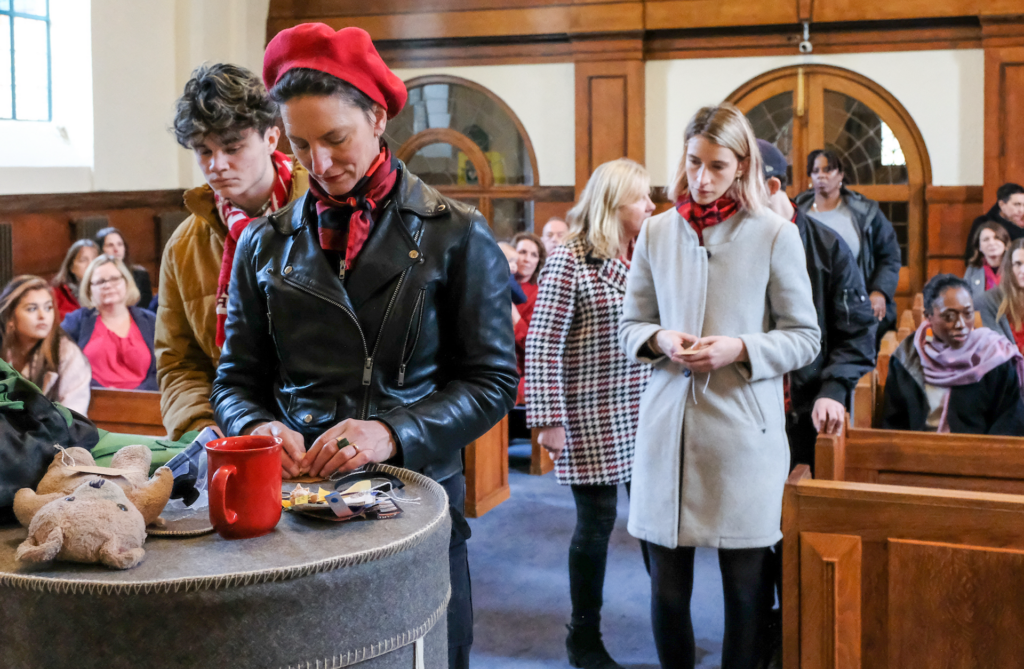
When Cathleen, a registered nurse, passed away at Hinds Hospice in Fresno, no mortuary was called due to previous planning. The Fresno County Coroner's Office transported her to their facility and kept her until her funeral Jan. 26.

The morning of her funeral, she was placed in a silk-lined pine casket built by her husband and family friend Roric Russell.

She was wrapped in a quilt, and her husband of 38 years placed her favorite pillow, a Teddy bear and her guitar in the casket. Bob Carlin and Russell then transported her to the North Fork Cementer.

"I just wanted to help Bob out," Russell said. "I went with him (Bob) to the funeral home and the least expensive casket was $800. I asked if we could build a casket and the mortician told me that no one does that but there is no law against it. I asked Bob if he wanted to build one and he said yes. We bought the wood that day."

Plans for building the casket were found from an old Mother Earth Magazine article.

The Carlins had been together since they attended high school in New Jersey prior to moving to North Fork.

Bob Carlin said he felt good about building his wife's casket as it made the process much more personal.

North Fork musician John Kilburn gave Cathleen guitar lessons for 12 years and helped organize a life celebration, held Dec. 13 at North Fork Studio.

"We were able to honor Cathleen while she was still strong. She sang with us and people got to tell her what she meant to them. It was very powerful," Kilburn said.

I’ve only chosen extracts from the full news story, which you can read here. It stresses how much money all this saved. Sure, it does save money if you do it all yourself, but alongside the emotional value of the experience, that’s a detail.

Two big misconceptions going around at the moment: home funerals are for the skint; funeral pyres are for Hindus. Wrong on both counts. They are for everybody. It’s a choice.

Labels: , ,

Thursday, 11 February 2010

Open air funerals are go!

In the light of yesterday’s Court of Appeal judgement in favour of Davender Ghai and anyone else who wants to be cremated on a funeral pyre, Rupert Callender of the Green Funeral Company, and a Trustee of the Natural Death Centre, has this to say:

The verdict this Wednesday from the High Court accepting the legal arguments presented by The Anglo-Asian Friendship Society and supported by The Natural Death Centre in favour of outdoor funeral pyres is as cheering as it is unexpected. It seems that underneath its musty periwigs and robes, British justice can still feel its way to the spirit of an issue and move radically in favour of the individual.

Of course, this is only a battle that has been won, not the war. The next impenetrable ring of defence, our Orwellian and inscrutable planning system and our perversely selective Environmental Health department will no doubt dig in for a long siege. For those of us who dream of blazing hilltops lighting up the night sky and illuminating dancing crowds, we still have miles to go before we sleep.

The media have predictably missed the point, with all of the major papers failing to grasp the concept that this is a right won for us all, not just those whose religious edicts prescribe it.

The strength of feeling on this matter that I have encountered from ordinary middle class Devonshire folk is incredible. It seems our ancestral memory has been stirred and will not lie down. Only this morning I encountered a woman who railed against not being able to cremate her mother in this way, and the spiritual paucity of what she had to settle for, the ubiquitous twenty minutes in a council run crem.

This is what has really cracked today, the one-size-fits-all funeral box that we have been squeezed into for so long. The people who manage our death rituals, particularly big funeral chains and crematorium consortiums, can be left in no doubt that the fundamental template no longer fits. Convenience can no longer dictate the ritual.

It is of course the crematoriums that are best placed to effect any changes; they solve many of the planning issues by existing already. Crematoriums are divided into those that are privately run, some by big players, and those that are managed by the council. Despite being heavily subsidised with our council taxes, it is the municipal ones that are shabby and run down. In one of our local urban ones, you are locked into a Victorian chapel for twenty minutes, so woe betide any latecomers, and the end of the service is marked by a noise reminiscent of the opening scenes of “Porridge.” The privately run ones, while still being deep in the belly of the capitalist beast at least are open to the whiff of consumer concern. We at the NDC have done our best to tempt them with new technologies, specifically Cryomation and Resomation, but we have also tried to sow seeds of change about how the ritual itself is managed, not just the mechanics of body disposal.

Integrating an area for outdoor cremations would be easy in a practical sense, and show that they do indeed “get it.” It is not quite the showy druidical theatrics of Dr Price that so many of us long for, but it is the beginning of something profound.

Ed’s note: Quoting the Press Association story: “the judgment goes on to state that the difficulties which may be thrown up by planning and public health legislation, should an application be submitted, have not been considered as part of this judgement.


"Furthermore, the method of burning associated with funeral pyres is not covered by any regulations which currently only apply to cremators powered by gas or electricity which are designed to maintain environmental standards, in particular air quality.


"Following the judgment, all local authorities will await further guidance from the Home Office and Defra as regards any proposed regulations or legislation which may control the proposed manner of cremation to ensure environmental standards and public health are protected."

Labels: ,

Monday, 25 January 2010

Conspicuous combustion

No new technology devised for the improved disposal of dead bodies has managed to achieve both efficiency and spectacle. There’s a perfectly good reason for this: the brains behind cremation and cryomation and resomation never reckoned spectacle to be a selling point. After all, funerals in the UK are private events, most of them. When they aren’t, it’s the processional that’s spectacular, not the disposal. Where’s the climax point in such a funeral? I’m not at all sure that there is one. Ought there to be? I don’t know. What do you think?

Over in Pattaya, Thailand, there’s a foreigner who records his assorted ramblings in a blog. When I say ramblings, I’m using his word. I’d have gone one better. It’s a good blog, an interesting read, and our rambling foreigner is a good photographer.

He recently witnessed the spectacular funeral pyre of a local Buddhist monk. So long did the construction of the pyre take, the monk had been dead for a year before being able to check out on it. At the top, a pic of the pyre. According to our rambler: “the pyre was an impressive sight, and they had even built in a degree of animation. Yellow tapes extended out on both sides into temple buildings, and unseen hands were pulling them to flap the wings and move the elephant head and trunk.”

Below is a photo of the pyre in its full glory. Read the blog post and see more photos here.


Labels: ,

Tuesday, 19 January 2010

Earth, wind and pyre

The be-wigged hair-splitters are having a sprightly time of it in the Appeal Court, where Davender Ghai is demanding the right to be burned, when he’s dead, on an open air funeral pyre.

This is a matter of concern not just to those Hindus who want what Baba Ghai wants, but to anyone who wants to be burned on a pyre. There’s nothing exclusively Hindu about a pyre. The Natural Death Centre is right behind Davender Ghai’s appeal, and Rupert Callender has written in support of him:

It is a mistake to see this legal challenge as coming from a minority group seeking a religious right that is alien to us, it is actually part of a wider demand for social change and as the recent excavations at Stonehenge are revealing, a part of our own indigenous cultural heritage. Rituals involving fire for purification, celebration and seasonal marking abound all over this country. The revived Beltane celebrations in Edinburgh are attended by over 12 thousand people. Up Helly Aa, the Viking fire festival in Lerwick in Shetland is the largest such ritual in Europe. The town of Lewes in Sussex has retained an extraordinary and enviable continuation of culture and identity based entirely around the bonfire celebrations of November The 5th, and let us not forget the public outdoor burning of the druid Dr Price in front of a crowd of twenty thousand, whose challenge was influential in legalising cremation in the first place.

In court yesterday the arguments swirled around what constitutes a building. Ramby de Mello, representing Davender Ghai, offered this definition:

“The expression crematorium should mean any building fitted with appliances for the burning of human remains. ‘Building’ is not defined. We say it should be given a broad meaning.”

At close of play yesterday, the mood in the Ghai camp was upbeat. Given their mood at the start of proceedings, this is encouraging. Today should be interesting.

Read the account in the Times here.

Labels: ,

Tuesday, 12 January 2010

Finding Valhalla

A friend writes. She is to be interviewed for the talking wireless. They’re going to want her take on Viking funerals. What, she wonders, are my views on Viking funerals? Can you, I wonder, help?

Interesting territory. We think of the classic Viking funeral as a blazing longship, bearing the corpse of a chieftain, drifting slowly and spectacularly across the sea. This is mostly myth. Where immolation took place in a longship it normally happened on dry land. The ship would customarily contain grave goods of all sorts, of course, we’re comfy with that, but it would also contain, often, slaughtered horses and servants. We’re not quite so comfy with that, and not just because we read the Guardian or suffer from servant envy.

And while that was one way the Vikings did funerals, the blazing longship, they weren’t one-trick ponies, they had others besides, and I’ve blogged about them. Here.

History be damned. There’s nothing more subversive of mystery and wonder than party pooper facts. What’s interesting is what survives: the glorious myth. And what’s interesting about the glorious myth is that it continues to exert such a strong hold on our twenty-first century imagination.

Why?

Because it meets so many of the needs of the living. Those needs are timeless, of course. They are aesthetic, emotional, spiritual and practical.

In terms of practicality, a holocaust is a good way of disposing of a dead body. Beyond that, it is spectacular. The flames rise (vertically) to the heavens as the wind fills the longboat’s sails and it journeys (horizontally) to the horizon in a way which mirrors the words of the Christian prayer: “But as thou didst not lose them in the giving, so we do not lose them by their return. For not as the world giveth, givest thou, O Lord of souls: that which thou givest thou takest away: for life is eternal, and love is immortal, and death is only the horizon, and the horizon is nothing save the limit of our sight.”

There is compelling emotional and spiritual appeal in this imagery, of journeying, transition, transfiguration and consummation (deliberate pun). The spirit rises as the craft moves over the face of the waters; that which is earthly is subsumed by the sea. All the elements are present: earth, air, fire, water. And there is an inexorable dynamic.

Is it that we yearn for Viking funerals because modern funerals fall so dismally short on all fronts? They do. don't they? Above all, they lack movement, and we especially need to rediscover that. Burial still meets lots of needs if there is a strong element of processional. Cremation, on the other hand...

So perhaps we should apply a Viking test to all funerary rites. This would produce interesting results, especially at a time when we are looking for an alternative to cremating dead people in incinerators. What do you think a Viking would say if you tried to interest him or her in cryomation? Sorry, I don’t know the ancient Norse for the predictable expletive, but you know its translation.

All of which leads to the conclusion that instead of looking for smart technology to dispose of our dead we need something altogether more retro. The solution to the problem of the dismal industrial cremator suddenly becomes crystal clear.

The open air funeral pyre.


Please add your helpful thoughts about Viking funerals in a comments box below. Oh, and click on the pic above to make it bigger.

FOOTNOTE: Read about the Viking funeral of Tal Stoneheart, brother of the Lib Dem MP Lembit Opik, here.

Labels: ,

Sunday, 8 November 2009

Open air cremation - it's for all of us

Following my post of yesterday, I have had the following response from Andrew Singh Bogan:

Dear Charles,

Thank you for your email; I read the blog with interest and have taken time out of my hectic schedule to submit this response.

The EHRC website (http://www.equalityhumanrights.com/) advises that their "...job is to promote equality and human rights, and to create a fairer Britain. [They] do this by providing advice and guidance, working to implement an effective legislative framework and raising awareness of your rights."

Section 3 of the Equality Act 2006 imposes a general duty on the Commission to conduct its functions with a view to encouraging and supporting the development of a society in which human rights and equality are respected and protected. This includes promoting understanding of the importance of equality and diversity, encourage good practice in relation to equality and diversity and to enforce the equality enactments. Also, promoting importance of the understanding and protecting of human rights, to promote awareness and to encourage local authorities to act compliantly with human rights.

The EHRC, in their application, say that they wish to inform the court as to the UK's obligations to protect minority rights under a number of different international instruments, including the one that you cite. (Incidentally, our counsel did bring these to the attention of the High Court but they appear to have been overlooked). That is but one strand to their expected argument which we expect will deal with the wider concern of "promoting understanding of the importance of equality and diversity and to encourage good practice in relation to equality and diversity".

Turning to your specific concern, the Appellant's case is based in entirety on his religious belief which stipulates an open air cremation. Were it not for his faith he would not have brought his claim. However, I want to make it clear that the case is a much wider one and its public importance is NOT solely limited to Hindus or any minority religious/ethnic group. To think so is to offend the very nature of the mutual tolerance and respect that the Appellant is so vigorously fighting for in his appeal.

Having spoken to our counsel this morning, it is perhaps understandable that the term "discrimination" automatically draws connotations of ethnic/religious minorities. Discrimination, as protected under article 14 of the European Convention of Human Rights (part of the Appellant's argument before the court) however is a very wide and powerful tool for all strands of society. It includes within its definition cultural belief, expectation and practice by society as a whole. To interpret this case as being by a Hindu for Hindus is to do it a serious injustice. The Sikh party who has intervened in the case does so not on the basis of religious belief (they accept that open air cremation is not a religious belief for them) but solely on the basis of culture, tradition and perhaps most importantly for your purpose FREEDOM OF CHOICE as enshrined in article 8 of the European Convention of Human Rights. They argue that if they choose to undergo natural cremations, the authorities ought to recognise their right to so opt and show them the tolerance and respect to do so. Like Rupert Callender, their intervention to secure the option is driven by their ritual practices as part of their culture and identity as a distinct group. Those who are subscribers to your organisation are entirely the same and represent your own distinct group.

To answer your question head-on, this is very much a matter of individual liberty for all citizens of the UK who choose, for whatever reason, to engage in natural cremation. For all who so choose, we should ALL get behind this appeal now because it greatly benefits us ALL.

If the Appellant wins - we ALL do!

In addition, if we are successful in our appeal then the guidance of the Court of Appeal will have wider implications for other aspects of society who wish to secure the right to engage in a genuinely held belief, ritual, custom or practice no matter how obscure it may objectively seem. The connotations are far too wide to cover here. This case as correctly been touted as the biggest case on discrimination thus far and it truly is history in the making.

Finally, I, as does my counsel, agree with Jonathan Taylor, who says "just as it would constitute religious discrimination to disallow Hindu open air cremations, it would be equally discriminatory to confine this right to a minority, or for that matter even to a majority". The application for intervention by the EHRC stands us in good stead in our fight against the authorities in so ensuring and we should all get behind it.

All the best,

Andrew

www.anglo-asian.org

Labels:

Saturday, 7 November 2009

Open air cremation - latest news of the appeal

On 19 and 20 January 2010 the Court of Appeal will hear the appeal of Davender Kumar Ghai against the prohibition of open air cremation upheld by the High Court in May 2009. It was a case made notorious by the intervention of Justice Secretary Jack Straw, who asserted that indigenous Britishers would be "upset and offended" by funeral pyres and "find it abhorrent that human remains were being burnt in this way". Read previous blog posts here and here.

I have just had an email from Andrew Singh Bogan, legal co-ordinator of the Anglo-Asian Friendship Society:

The Equalities and Human Rights Commission has been granted permission to formally intervene in the legal proceedings. They will present their own arguments before the Court of Appeal in support of our arguments.

Given the Commission's prominence, resources and impartiality, it might be an idea for you guys to contact them directly to inform them of your support. This could enable your support to receive far greater exposure...and allow help us to escape censure for submitting late evidence!

However, the Commission's legal team (headed by counsel from Matrix Chambers) would not appreciate any possibility of us 'feeding' them evidence, so any approach should make clear the independence and impartiality of your support. It is fine to say you recently made with the AAFS charity [Anglo-Asian Friendship Society] and we have informed you of the Commission's intervention.

Why has the Equalities and Human Rights Commission (EHRC) felt impelled to intervene? Because it wants to “draw the court’s attention to Article 27 of the International Covenant for the Protection of Civil and Political Rights (ICCPR) which contains the ‘right of ethnic, religious or linguistic minorities to enjoy their own religion [and] to profess and practice [sic] their own religion.’” It also wants to draw the attention of the court to related declarations by the United Nations and the Council of Europe.

Is it good to see an influential body like the EHRC get behind this appeal? Up to a point, perhaps. But I wonder if it could be counter-productive and play to the xenophobic lobby, something which Straw has already so deftly and successfully done.

Is this appeal just about securing an exemption for a tiny minority of Hindus to practise their faith? I earnestly hope not. It has to be about securing the right of anyone at all, of much faith or none whatever, to opt for open air cremation. As Rupert Callender of the Green Funeral Company has observed: “The recent excavations at the Stonehenge complex show that ritually cremating our dead outdoors is at the heart of our culture. This is about reclaiming ritual ... It is what the natural death movement is all about- the truth.

I hope that Andrew—who is India at the moment, and very busy—will be able to clear this up for us. Either this is a matter of individual liberty for all citizens of the UK, or it is nothing at all. My jury is presently AWOL.

If you would like to offer your support, email Matrix Chambers: katy.reade@equalityhumanrights.com


Labels:

Thursday, 22 October 2009

This is a burning issue. Please act now!

http://www.lifeandlove.tv/video.cfm/cid/2003/vid/1190/preview/true

The video above (I'm sorry, I can't embed it) shows, or purports to show, an open-air cremation in Colorado. I am indebted to m’learned friend, the humane, wise and scholarly Pat McNally, for putting me onto it. It is the subject of his latest blog post. If you are not a regular reader of Pat’s blog you can look forward to many happy hours in his archive. It’s a treasure trove.

Here in the UK the Anglo-Asian Friendship Society is preparing to go to Court of Appeal to contest the ban on open-air cremation upheld in the High Court in May 2009, a case notorious for the intervention of that conspicuous enemy of liberty, the Justice Secretary Jack Straw. He placed open-air cremation in a context of cultural barbarity, opining that evolved, indigenous Britishers would be "upset and offended" by funeral pyres and "find it abhorrent that human remains were being burnt in this way". He thus set open-air cremation firmly in its place alongside honour killing, the stoning of homosexuals, the mutilation of minor criminals and all manner of exotic, benighted, imported cruelty. The message to our brown-skinned brothers and sisters was clear: you can’t come over here and do that sort of thing in a civilised country like this.

There was very little backlash against Mr Straw’s disdainful dismissal of the funerary rites of a mere 800 million Hindus worldwide. Indeed, many British Hindus lent strength to his argument by declaring that they were perfectly happy to go down to t’crem and be clinically incinerated like anyone else.

Straw created a potent sideshow. Open-air cremation is, he said, culturally alien and aesthetically unacceptable. Neither point of view stands a second’s scrutiny, yet he carried the day. His reasoning was puerile and you need to challenge it.

First, let’s lift open-air cremation out of the cultural cesspit into which Straw contemptuously dumped it. It is not the preserve of a minority of Hindus. It is a disposal option favoured by people of all sorts and all races, of all religions and of none.

And we’re not talking about opening floodgates here. If open-air cremation were to be re-legalised (its present ban is of dubious legality), would the sun all at once be darkened by the smoke of burning carcasses? Would it happen in beauty spots, waste ground, people’s back gardens? Of course not. Firstly, only a very few people would opt for it. Secondly, they would do it lovingly, privately. No one would notice—unless they’d been invited.

There’s a very simple issue of personal liberty at stake here. Nothing should be allowed to stand in the way of people whose actions adversely affect no one else.

There’s also an irony at work. Step forward, please, Dr Price!

Who?

William Price first attracted attention as a schoolboy by reading poetry as he walked through the countryside naked. After qualifying as a doctor he became involved in revolutionary politics. He was a druid, given to wearing a red waistcoat, green trousers and a fox pelt on his head.

In 1883, when he was 80, he took as his lover a woman sixty years younger. With her he had a son whom he named Jesus Christ. Jesus died when he was five months old. In accordance with ancient druidical practice, Dr Price proceeded to burn his body. A horrified crowd gathered and snatched the body from the flames. Price was prosecuted. He was acquitted, and the judgement delivered that cremation is legal so long as no nuisance is caused to others.

It was a landmark ruling. When it was made, the furnace of Cremation Society’s first crematorium at Woking had lain unfired since its installation five years previously, timorously awaiting a legal green flag. Dr Price secured the breakthrough the Cremation Society had been hoping for and, without further ado, the pioneering (if prostrate) Mrs Pickersgill became Woking’s first client.

The cogency of the judgement remains incontestable. So long as no nuisance is caused to others, cremation is legal. The irony of the judgement remains poignant: it was brought about by an indigenous open-air cremationist.

If you want to lend your voice to the Anglo-Asian Friendship Society’s appeal, please write now to Andrew Singh Bogan: info@anglo-asian.org.

Labels: ,

Tuesday, 4 November 2008

Forward backwards!

My good friend the embalmer is not noted for halfway utterance, nor for half-tones in her vocabulary. She calls a spade a spade and hits you with it if she thinks you’re wrong, thwang thwang. She’s never less than invigorating.

One of the themes she warms to hotliest is that of the present reinventing the past. “What do they think is so new about that?!” she’ll expostulate in response to some new funerary trend. “It’s all been done before!!”

Quite right. So it has. Personalisation, for example. Everyone’s talking about that -- unique funerals for unique people. Turns out the Vikings were doing it more than a thousand years ago.

They were more like us than you might think, the Vikings -- and I’m not inviting comparison here with Friday night revellers in our city centres.

For starters, they had no defined religion. Instead, according to Professor Neil Price, Chair of Archaeology at the University of Aberdeen, they “made up a set of spiritual beliefs, which were then acted out at the graveside … They were aggressively pagan and strongly anti-Christian.”

Just like so many of us.

Possibly more emotionally sophisticated. Professor Price observes “how slim they perceived the boundaries to be between life and death”. We haven’t got there, yet.

He talks about burial rituals which became a form of theatre lasting up to ten days, during which mourners told stories about men and gods -- stories “intended to provide the deceased with a poetic passage into the next life,” stories which predate the sagas and may even be the progenitors of Norse mythology.

We haven’t got there, yet, either, but the trend towards more participative funerals is, er, a move in the right direction.

As for personalisation, they benchmark it. “No two graves were the same,” says Professor Price, who has studied thousands. “Some bore evidence of a military career, with whole ships containing the corpse left open. Other graves were found to have had animal remains - one had no fewer than 20 decapitated horses - and occasionally there were human remains as well. Some Vikings were buried with their wives and families; others were laid to rest in more simple single graves.”

Way to go.

It turns out that the Vikings’ reputation for raping and pillaging is unmerited. They were actually far more interested in poetry and spirituality. A medieval English chronicler, John of Wallingford, observed that they combed their hair every day, washed every Saturday and changed their clothes regularly. He meant it disparagingly.

We’ve a long way to go to catch up with our forefathers. Indeed, you could say that Viking funerals illustrate how the forward march of our civilisation has in fact been a retreat into fear and impotence.

Labels: , ,

Wednesday, 15 October 2008

Blazing row

"The Hindus of Britain have never asked for anything," says Mr Gai of the Anglo-Asian Friendship Society "but we're not asking for much, just to cremate our loved ones in the way our religion says it must be done."

The issue of open-air cremation is hotting up as Newcastle-based Mr Gai prepares to go the High Court next month to demand the right to have his body disposed of in accordance with his religious beliefs.

He’s got precedents on his side. In 1884 the colourful Dr William Price cremated his five month-old son Jesus Christ on an open-air pyre. He was prosecuted, and acquitted on the grounds that cremation is not illegal if it creates no nuisance. When he died, Dr Price himself went up in smoke on top of two tons of coal. His successful test of the law was the green flag the Cremation Society was waiting for. Britain’s first-ever crematorium, at Woking, was in business at last, its first customer the pioneering (if inert) Mrs Pickersgill.

There are other precedents. You can read about them here.

Mr Gai’s challenge will, doubtless, come down to an evaluation of both the aesthetic and environmental effects of outdoor cremation. It is not long since measures to control foot and mouth disease in the UK blackened the sun and cloaked the countryside with the smoke and stench of burning cattle carcases, so no problem there. But those innocent beasts did not have teeth filled with mercury amalgam, and vaporised mercury is particularly nasty emission.

Invocation of a Supreme Being is often an effective way of bypassing standard procedures, leaving those who defer either to no deity, or to one with no political clout, in second-class-citizen position. There was a row last month over a man whose body couldn’t be buried on a Saturday because he wasn’t a Muslim. Read about it here.

Let us hope that Mr Gai will be successful and that the judgement will permit open-air cremation for anyone who opts for it. Does that mean that the derelict shipyards of the Tyne will be replaced by burning ghats?

No -- regrettably or otherwise. Open-air cremation is perceived to be a religious requirement only by some Hindus. And for a very few non-Hindus it is an elemental desire which cannot be reduced to a mere reason. It’s a tiny niche market, but one which nevertheless deserves to go the way of its choosing.

Let’s not forget that our ‘bonfire’ derives from the Middle English ‘bone fire’.


Labels: ,